Hybrid deep-learning model to forecast the shale gas production based on decomposition-reconstruction principle
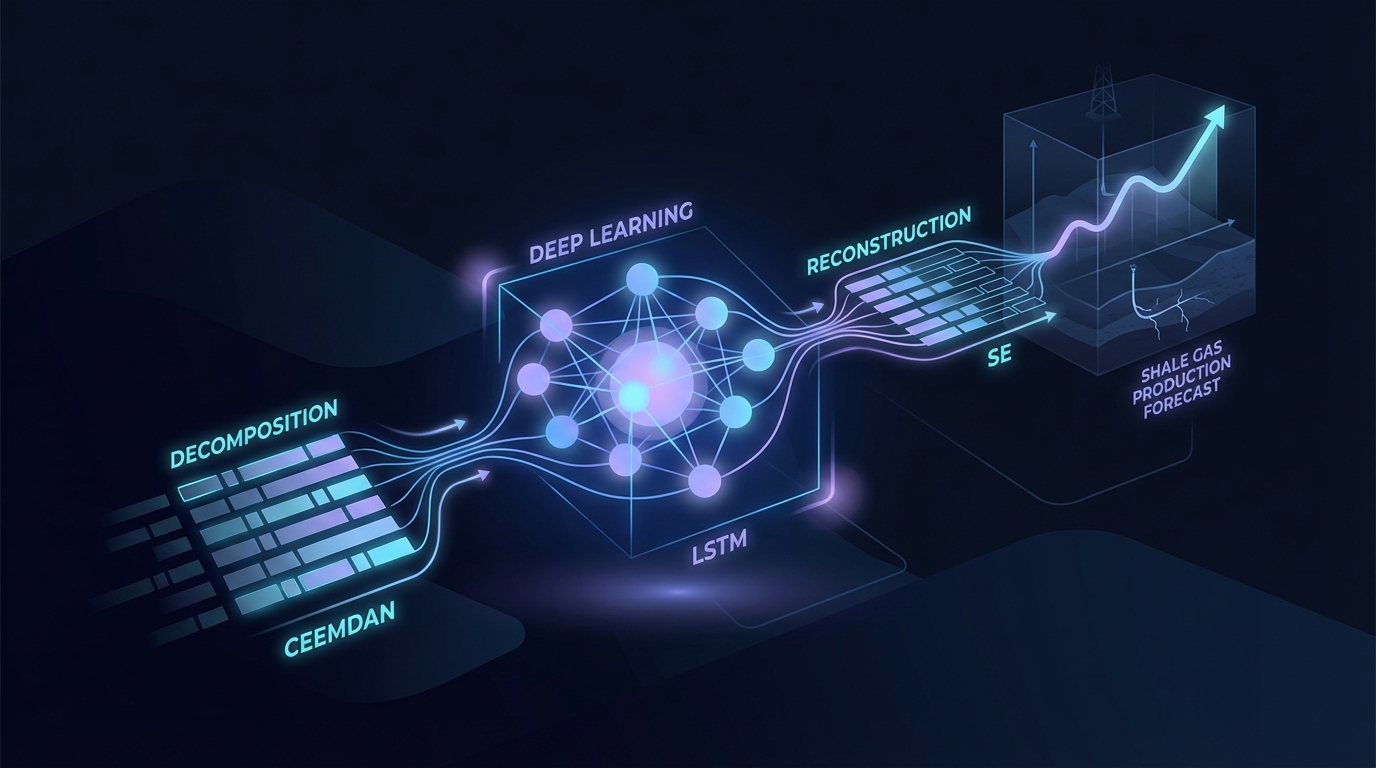
Image generated by Gemini AI
A new hybrid model, CEEMDAN-SE-LSTM, combines deep learning with decomposition techniques to enhance gas production forecasting in shale reservoirs, addressing challenges posed by non-linear and non-stationary data. This model significantly improves prediction accuracy while reducing computational costs, validated against multiple datasets. The findings suggest it could inform better production strategies.
Hybrid Deep-Learning Model Enhances Shale Gas Production Forecasting
A new hybrid deep-learning model has been developed to forecast shale gas production more accurately. This approach integrates data-driven techniques with decomposition methods to address challenges in predicting production dynamics from hydraulic fracturing.
The study underscores the importance of precise gas output estimates due to the ultralow porosity and permeability of shale formations. Traditional prediction methods have struggled with the nonlinear nature of production data.
Model Development
Researchers evaluated existing data using decline curve analysis and developed hybrid models combining long short-term memory (LSTM) and gated recurrent unit (GRU) networks with decomposition techniques like empirical mode decomposition (EMD) and complete ensemble empirical mode decomposition with adaptive noise (CEEMDAN).
The resulting CEEMDAN-SE-LSTM model improves forecasting capabilities while minimizing computational costs. It has shown promise in predicting production data effectively.
Results and Validation
Performance evaluations demonstrate the CEEMDAN-SE-LSTM model's superiority in capturing operational disruptions and fluctuations in production rates. Validation against two shale gas production datasets confirmed its reliability.
Implications for Gas Production
The model's ability to deliver precise forecasts enables operators to optimize development plans and improve efficiency in gas extraction processes.
Related Topics:
📰 Original Source: https://doi.org/10.1115/1.4070746
All rights and credit belong to the original publisher.